
Casual/Tease - The Memorial For Those Who Did Not Fall In War - Opening Weekend
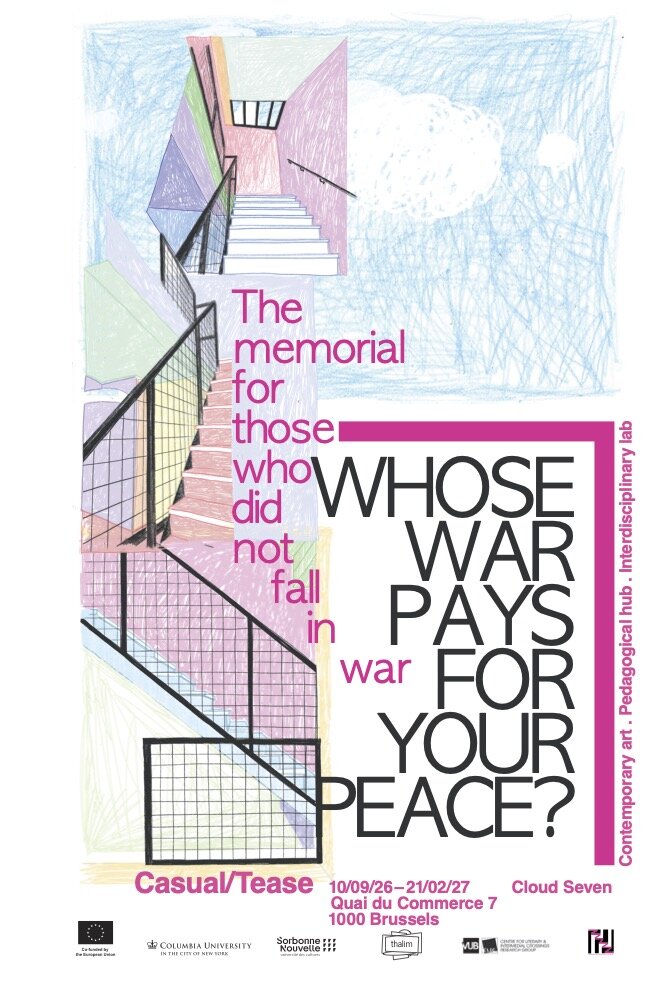
What does it mean to be “at peace” in the twenty-first century, when the societies that consider themselves peaceful remain entangled in the structures of war — through global arms economies, inherited trauma, military pollution and technologies developed for conflict?
This September, The Memorial for Those Who Did Not Fall in War arrives at Cloud Seven in Brussels with Casual/Tease, an exhibition bringing together more than thirty international artists from Frédéric de Goldschmidt's collection, including Reza Aramesh, Kader Attia, Julian Charrière, Kendell Geers, Shilpa Gupta, Mona Hatoum, Kapwani Kiwanga, Walid Raad and Danh Vō, as well as invited artists including Baptist Coelho, Benoît Jacquemin, Vera Kox, Ismail Matar, Pratchaya Phinthong and Zgjim Zyba.
Together, they explore how war and its consequences permeate everyday life — including in societies that consider themselves to be at peace. What first appears casual gradually exposes the systems beneath it: technologies travelling from battlefield to home, pleasures sustained by economies that arm wars elsewhere, and intimate objects through which violence persists long after conflict has ended.
Casual/Tease marks the second chapter of The Memorial for Those Who Did Not Fall in War, a cross-border lab bringing together art, research and education to rethink war and peace in the 21st century, developed by Columbia University’s Global Center for Peace Innovation. Bringing together contemporary art, research and education, the project questions conventional distinctions between peace and war, examining the global economies, infrastructures, environmental consequences and inherited traumas that connect the two.
Curated by Hadas Zahavi, Founding Director of Columbia University’s Global Center for Peace Innovation and initiator of The Memorial, Casual/Tease brings these questions into the exhibition space, directing our attention precisely to the places where war seems absent.
"We think we know what harm looks like. From breaking news to social media, we are saturated with a constant stream of images of victims set against collapsed facades, darkened walls, dust hanging in the air, and streets brought to a halt under rubble. In this flow of images, we learn where to look for casualty and, just as crucially, where not to: within the uninterrupted course of day-to-day routine. Casual/Tease lingers exactly where nothing seems to happen, within the casual continuity of everyday life: a quiet view from a window onto a flowering boulevard, a household ladder leaning within reach, a handmade ceramic vessel ready to hold a bouquet. Each work in Casual/Tease first appears as a small, innocent fragment of daily life, caught in a fleeting moment of ease. Look a little longer, however, and that ease begins to fracture. The window view borrows the gaze of a military drone; the ladder becomes the impossible reach for food amid genocide; the delicate vessel reveals the form of a grenade, handmade in wartime Japan. To look here, then, is not simply to uncover what was hidden, but to confront what perception itself has been trained to overlook."
— Hadas Zahavi, curator of Casual/Tease
The exhibition inhabits this uneasy proximity between the casual and the casualty. Rather than depicting war through familiar images of destruction, it traces the structures, technologies, economies and material residues through which violence becomes embedded in what appears ordinary and peaceful.
Following its first chapter in Paris, The Memorial for Those Who Did Not Fall in War now takes root in Brussels before continuing to New York in 2027. Conceived as a nomadic project rather than a fixed monument, it materialises differently in each city through exhibitions, research, education and public programmes, responding to the communities and political contexts it encounters.
Looking differently
Rather than directing our gaze towards the sites where violence is most visible, the exhibition asks us to look at the apparently peaceful spaces connected to its production.
These include university laboratories associated with human progress where technologies of warfare take shape; offices where their production is financed and their sale negotiated; everyday commercial routes along which weapons circulate among ordinary goods; and the safe distances from which armies deploy remote warfare technologies.
The exhibition connects these spaces to the other end of the same continuum: places where the visible event of war may have passed, but its consequences continue. People walk across poisoned ground, breathe contaminated air and inhabit landscapes scattered with the remnants of previous conflicts. Military violence persists in materials and environments long after the moment of impact has disappeared from view.
Casual/Tease holds these two realities together: the places where the appearance of casual everyday life is preserved, and the places where that same everyday life has been disrupted or permanently altered.
In doing so, the exhibition asks not only who becomes a casualty of war, but also from where those casualties are produced — and how close those places may be to our own everyday lives.
Artists and works
Working across sculpture, photography, installation, textiles, film and site-specific interventions, the artists in Casual/Tease approach these questions through objects and images that frequently resist immediate interpretation.
List of participating artists:
Reza Aramesh, Julieta Aranda, Kader Attia, Nina Berman, Julian Charrière, Baptist Coelho, Detex, Kendell Geers, Shilpa Gupta, Dan Halter, Majd Abdel Hamid, Mona Hatoum, Hideyuki Ishibashi, Benoît Jacquemin, Will Kerr, Lesia Khomenko, Kapwani Kiwanga, Daria Koltsova, Vera Kox, Anton Kusters, Rachel Labastie, Emilio López-Menchero, Edgar Martins, Ismail Matar, Aimé Mpane & Jean Pierre Müller, Pratchaya Phinthong, Walid Raad, Shareef Sarhan, Omid Shirazi, Laure Tixier, Danh Vō, Meltem Yildiz, Mohammad Zaza, Zgjim Zyba
Rather than illustrating conflict, their works reveal its presence indirectly. Familiar forms carry histories of conquest; apparently neutral technologies reveal military origins or applications; objects and landscapes retain the residues of previous wars; and ordinary comforts become connected to economies capable of sustaining violence elsewhere.
publié le 02/09/2026
Jeudi: de 14:00 à 21:00
Vendredi: de 11:00 à 21:00
Samedi: de 11:00 à 23:00
Dimanche: de 11:00 à 18:00
Du 10 au 13 septembre
Dans la même catégorie:
 | Mind of a Serial Killer : L'Expérience (Du 18 juillet au 30 septembre - Bruxelles) |
 | Béjart-Bruxelles (Bruxelles) |
 | Moof Museum (Bruxelles) |
 | Balade numérique : Un costume à la mesure de Jeanneke (Bruxelles) |
 | Choco Story Brussels - le Musée du Chocolat (Bruxelles) |